


Are you still hesitating to take the plunge because you’ve often been told that laser hair removal for dark skin is too risky or ineffective? It’s time to put these misconceptions to rest, as technological advances now ensure absolute safety and outstanding results for medium to dark skin phototypes. We explain how the Nd:YAG laser targets the hair without damaging your melanin and share expert criteria to help you choose the right laser hair removal center, so you can enjoy smooth skin with complete peace of mind.
Table of contents
Dark Skin and Laser Hair Removal: Debunking the Myths
No, laser hair removal is not dangerous for you
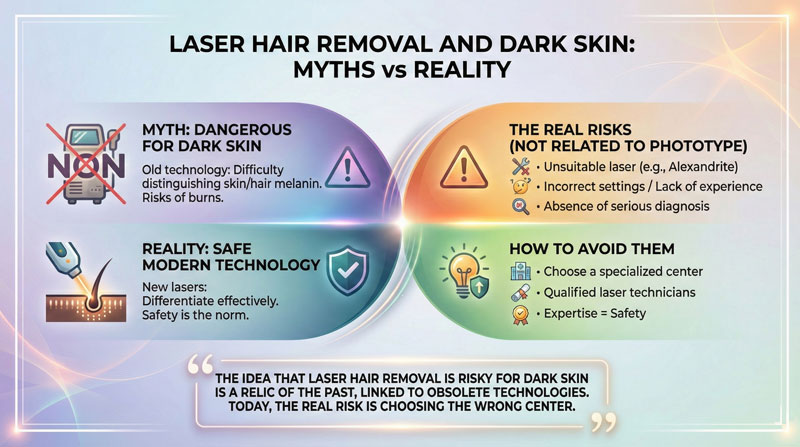
Let’s be clear: the idea that laser hair removal for dark skin is inherently dangerous is completely outdated information. This concern may have been justified years ago, but technology has completely changed the game.
The issue was never the skin color itself, but the inability of older lasers to distinguish between skin melanin and hair melanin. This technical limitation was what caused the risk of burns or pigmentation issues. Today, this is no longer the case.
Safety is now the standard, provided the right choices are made from the very beginning.
The real sources of risk (and how to avoid them)
f problems occur, they are not due to skin phototype. They are almost always linked to poorly controlled human or technical factors. This is a crucial distinction.
In reality, complications often stem from a series of avoidable mistakes that you absolutely need to be able to identify:
- Use of an unsuitable laser technology (such as Alexandrite).
- Incorrect device settings due to lack of experience.
- No thorough skin diagnosis before starting treatment.
Choosing a specialized center where trained laser practitioners work, such as Epilia, is the best guarantee. Their technical expertise is what effectively eliminates these risks. The choice of the center is therefore far more decisive than skin color.

The idea that laser hair removal is risky for dark skin is a thing of the past, tied to outdated technologies. Today, the real risk lies in choosing the wrong center.
The technology that changes everything: the Nd:YAG laser
Comment ça marche, simplement ?
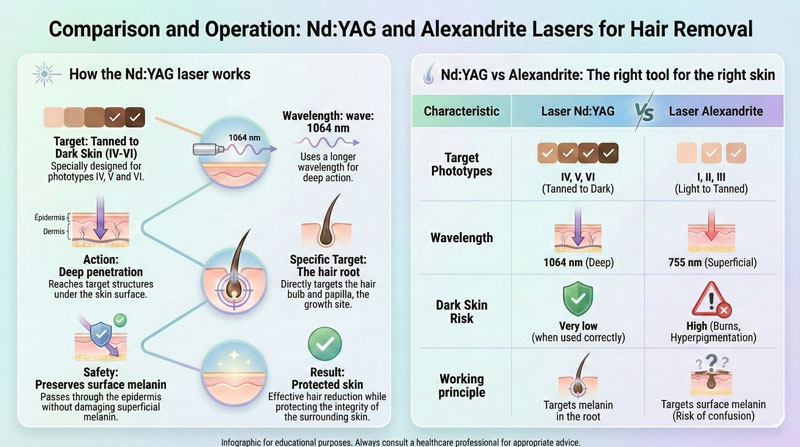
The Nd:YAG laser is now recognized as the gold standard for dark skin phototypes (IV to VI). Everything is based on one precise technical feature: its 1064 nm wavelength. This figure is truly the key to safety.
This unique wavelength allows the laser beam to penetrate deeply through the epidermis. It bypasses surface melanin to target the hair follicle directly, without affecting the melanin in the surrounding skin.
In short, the device targets the hair and only the hair. Your skin remains perfectly protected.
Nd:YAG vs Alexandrite: the right tool for the right skin
The Alexandrite laser is effective, but strictly reserved for light skin tones. Using it on dark skin is a major technical mistake, often leading to burns or persistent pigmentation spots.
To understand why choosing the right equipment is critical, here is a direct comparison.
| Feature | Nd:YAG Laser | Alexandrite Laser |
|---|---|---|
| Target phototypes | Medium to dark skin (IV, V, VI) | Very light to light-medium skin (I, II, III) |
| Wavelength | 1064 nm (deep penetration) | 755 nm (superficial penetration) |
| Risk for dark skin | Very low, almost none when properly used | High (burns, hyperpigmentation) |
| Mode of action | Targets melanin in the hair follicle deep beneath the skin | Targets surface melanin, risk of confusion with skin melanin |
Human expertise: the key factor in your safety
Having the right machine is important. Knowing how to use it to perfection is even better. That’s where human expertise makes all the difference.
The essential role of the laser practitioner
Technology alone is far from enough. The success of laser hair removal for dark skin relies almost entirely on the expertise of the laser practitioner. She is the one and the only one who operates the device.
Her role is essential: she analyzes your skin, distinguishes between phototype V and VI, and adjusts laser settings such as fluence. This level of precision is essential to ensure effectiveness without risk.
The best technology in the world is useless without the expertise of a laser practitioner who knows how to adapt it precisely to your skin, your hair, and your treatment history.
The first consultation: a non-negotiable step
Think of this initial consultation as the mandatory starting point of any serious protocol. It’s not just a simple administrative formality. It’s a moment to ask all your questions and ensure everything is clear.
What actually happens during this session includes skin assessment, hair analysis, and checking for contraindications. A small test patch is often performed to evaluate your skin’s reaction.
This is why centers like Epilia have made this first consultation free and a cornerstone of their approach. The priority remains complete transparency and your safety.

Your practical guide for successful sessions
The success of your treatment also depends on you. A strict discipline is your best ally to avoid setbacks.
To prepare properly without risking burns, here are the essential rules to follow before your session:
- No sun or UV exposure for 15 days prior.
- Shave the area 24 hours before (never wax or use an epilator).
- No self-tanning or photosensitizing products.
Once the session is over, your skin needs gentle care to recover without leaving pigmentation marks:
- Apply a soothing cream recommended by the center.
- Avoid heat, scrubs, and friction for a few days.
- Use a SPF 50+ sunscreen on exposed areas.
Results, number of sessions, and limits to know
Let’s be clear: laser hair removal for dark skin is not instant magic. The goal is a long-lasting reduction of 80 to 90% of hair. The laser only targets hairs in the growth phase. Patience pays off.
At expert centers like Epilia, a realistic range is recommended. Annual maintenance sessions may be necessary to sustain the results.
The laser is ineffective on very light, white, or red hair. In these specific cases, electrolysis remains the only viable solution.
Laser hair removal for dark skin is no longer a risk but a true liberation. Thanks to Nd:YAG technology and the expertise of specialists, you can finally enjoy long-lasting smoothness safely. Don’t let outdated beliefs hold you back treat yourself to this precious time-saving benefit and fully enjoy life.
FAQ : Laser Hair Removal for Dark Skin: Myths and Realities
Which laser is truly best suited for Black and mixed‑race skin?
Without any hesitation, the reference technology for phototypes IV to VI is the Nd:YAG laser. Unlike the Alexandrite laser, which is reserved for light skin, the Nd:YAG uses a specific wavelength (1064 nm) that penetrates deeper into the dermis. This allows it to target the hair follicle directly without being absorbed by the melanin in your skin’s surface, thus ensuring maximum safety.
Which laser is truly best suited for Black and mixed‑race skin?
Absolutely, the idea that laser doesn’t work on dark skin is an outdated myth. With the right technology, results are excellent, aiming for a long-lasting 80 to 90% hair reduction. You just need to understand that the treatment may require a bit more patience.
From what skin tone is the skin considered “too dark” for laser?
Good news: today, no skin is “too dark” for permanent laser hair removal. Thanks to the Nd:YAG laser, it is entirely possible to treat Black skin (phototype VI) safely. The only non-negotiable condition is to go to an expert center capable of precisely adjusting the device to distinguish hair melanin from the melanin in your epidermis.
Why is there talk of hyperpigmentation risks and how to avoid them?
Hyperpigmentation (darker spots) generally occurs when the laser overheats the skin instead of the hair, often due to unsuitable equipment or incorrect settings. To prevent this, always choose a practitioner using an Nd:YAG laser and strictly follow the guidelines: no sun exposure 15 days before and after the session, and always apply SPF 50+ sunscreen.
Are there any specific contraindications for me?
The contraindications are largely the same for all phototypes. Laser hair removal is not recommended if you are pregnant, breastfeeding, or taking photosensitizing medications. The crucial point for us is sun exposure: freshly tanned skin is an absolute temporary contraindication. This is why the free initial consultation is essential to confirm your eligibility with complete transparency.