


Tired of wasting your precious energy on repetitive hair-removal sessions that never provide the daily peace of mind you’re looking for? To optimize your beauty routine, understanding the laser hair removal vs. electrolysis comparison is the key step toward lasting freedom and a truly flawless, hair-free skin.
This expert guide helps identify the ideal technology for your specific profile and target areas, ensuring you make an informed choice between treatment speed and high precision for results that finally meet your expectations.
Table of contents
Two approaches, one goal: how does it work?
Laser hair removal: the power of light to treat the surface
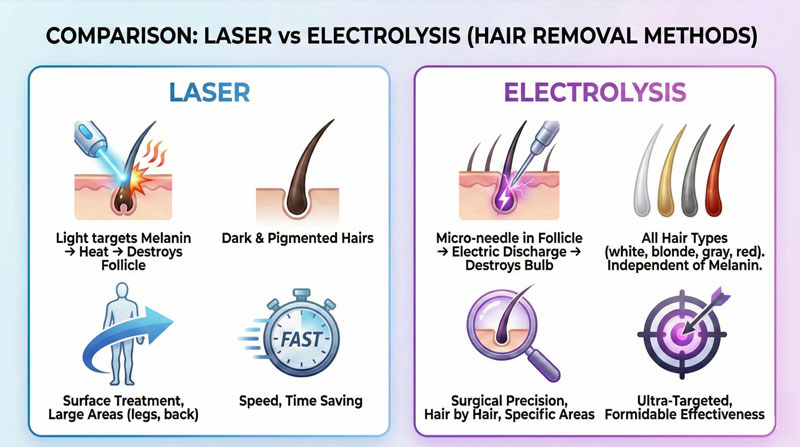
To fully understand the difference between laser hair removal and electrolysis, it’s essential to understand how light works. The laser beam targets melanin, the pigment in the hair. This light is absorbed and converted into heat. It is this heat that destroys the hair follicle at the root.
This method therefore depends on color. It works extremely well on dark, pigmented hair. The surrounding skin, which contains less melanin, is preserved.
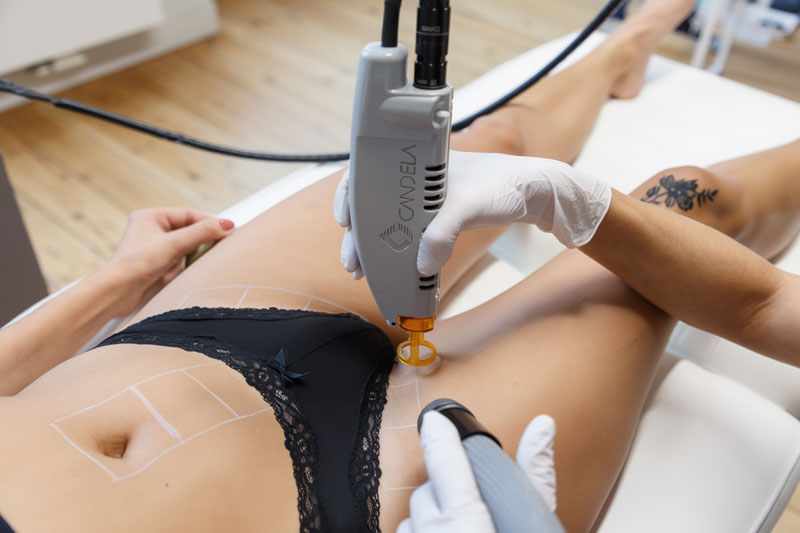
Laser hair removal treats an entire area by scanning the surface. It is an ideal solution for large areas such as the legs, back, or bikini line, offering a significant time-saving advantage.
Electrolysis: surgical precision, hair by hair
Electrolysis is a completely different method. A sterile micro-needle is inserted along the hair shaft, directly into the follicle. A small electrical current is then delivered to destroy the hair bulb at the source.
This point is crucial: the technique is independent of melanin. It destroys the hair regardless of its color. It is the only effective method for white, blonde, gray, or red hair.
It is an ultra-targeted procedure. The treatment is performed literally hair by hair. This high-precision work is much slower, but offers remarkable effectiveness on specific areas.

A solution for every hair: for whom and for which areas?
Laser hair removal, the ideal ally for large areas and pigmented hair
Are you hesitating between laser hair removal and electrolysis? If you have dark hair on light to medium skin, laser hair removal is ideal. It provides long-lasting reduction of hair growth on large areas such as the legs or bikini line.
It’s the perfect method to efficiently “clear out” the majority of hair. Your daily comfort improves from the very first sessions, freeing up valuable time.
Electrolysis, the queen of finishing touches and special cases
Electrolysis treats what laser hair removal cannot: light, white, or red hair. It is the essential finishing solution for everything that does not respond to light-based treatments.
It specifically targets isolated or resistant hairs. A stubborn hair on the chin or around the areolas? That’s where electrolysis truly excels.

Electrolysis is not an alternative to laser hair removal. It is its perfect complement for a flawless finish.
The comparison table for a clear overview
| Criteria | Laser Hair Removal | Electrolysis |
|---|---|---|
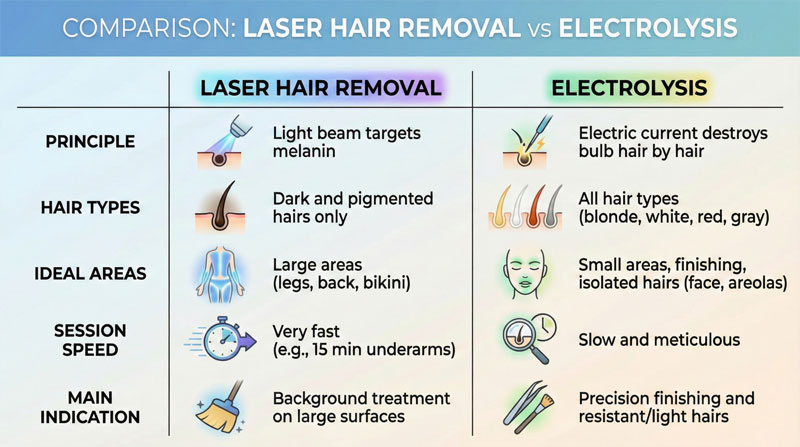
| Principle | Light beam targeting melanin | Electrical current that destroys the hair bulb hair by hair |
| Types of hair treated | Dark and pigmented hair only | All hair types (blonde, white, red, gray) |
| Ideal areas | Large areas (legs, back, bikini line) | Small areas, finishing work, isolated hairs |
| Session speed | Very fast (e.g. 15 minutes for underarms) | Slow and meticulous |
| Main indication | Base treatment for large surfaces | Precision finishing and resistant hairs |
Process and sensations: what can you realistically expect?
Beyond the technical aspects, what truly matters to us is the day-to-day experience. How does a session actually work, is it painful, and what pace should be followed to finally feel at ease?
Session frequency and duration: a marathon or a sprint?
When it comes to the laser hair removal vs. electrolysis comparison, laser is clearly the sprinter. Sessions are short and usually spaced about 6 to 8 weeks apart. This is the ideal solution to optimize our schedule.
Electrolysis, on the other hand, requires more perseverance. Since the treatment is performed hair by hair, sessions may be longer or more frequent at the beginning. It is a long-term commitment, often spread over several months. Consistency is key to permanently eliminating each hair during its growth phase.
Comfort, pain, and post-treatment effects
The sensation of laser hair removal is often compared to the snap of a rubber band against the skin. It can be surprising but is generally well tolerated, especially since modern devices include integrated cooling systems for maximum comfort. The discomfort therefore remains very manageable.
Electrolysis can feel more sensitive, as the action is extremely localized. It feels like a small, warm prick at the base of the hair. There is a heating sensation, but with very high precision.
After the session, mild redness is common with both methods. Electrolysis may sometimes cause tiny scabs, which usually disappear within a few days.

Laser and electrolysis: the winning duo for perfect results
So in the end, do you really have to choose? What if the best strategy were to stop pitting them against each other?
Why we don’t oppose them, but combine them instead
In an ideal world, a permanent hair removal protocol looks like this: you start with laser hair removal to eliminate around 80–90% of dark hair in a given area. It’s fast, effective, and truly life-changing on a day-to-day basis. You save an incredible amount of time, believe me.
Then, you move on to electrolysis. It comes in as a finishing step to target the last stubborn hairs or those that are too light for laser treatment. That’s where the laser hair removal and electrolysis duo truly makes sense: complementary technologies working at their best.
The secret to successful results: choosing the right center
Que vous optiez pour l’un, l’autre, ou les deux, une chose ne change pas : la nécessité de vous adresser à des professionnels qualifiés. Ne jouez pas avec votre peau.
A proper initial assessment is the key. An experienced practitioner will be able to evaluate your skin and hair to recommend the most appropriate and safest treatment protocol for you.
- Un premier rendez-vous d’information complet pour établir un diagnostic personnalisé.
- Des laseristes formées et expérimentées qui maîtrisent parfaitement les deux technologies.
- Des équipements performants et récents, garantissant une sécurité totale et une efficacité maximale.
- Une explication transparente et honnête du déroulement ainsi que des résultats attendus.
Inutile d’opposer ces deux technologies, elles forment le duo parfait pour une liberté totale. Le laser offre un gain de temps précieux sur les grandes zones, tandis que l’électrolyse sublime le résultat en éliminant les derniers poils résistants. C’est la stratégie gagnante pour une peau durablement douce, sans compromis sur votre emploi du temps.
FAQ : The differences between laser hair removal and electrolysis
Laser hair removal or electrolysis: which option is best for me?
The choice mainly depends on your hair type and the area to be treated. If you want to remove hair from large areas such as the legs or bikini line and you have dark hair, laser hair removal is the fastest and most effective solution. It allows an entire area to be treated in just a few minutes.
On the other hand, if you have blonde, red, white, or gray hair, electrolysis will be your only viable option, as laser hair removal cannot detect these hairs. It is also the ideal method for small facial areas or for removing the few remaining hairs after a laser treatment protocol.
Is electrolysis more permanent than laser hair removal?
Technically, electrolysis is the only method considered truly permanent, as it destroys the hair bulb individually using an electrical current. It works on 100% of treated hairs, regardless of their color.
Laser hair removal, on the other hand, provides a long-term permanent reduction, with an average hair reduction of around 80 to 90%. This offers excellent day-to-day comfort, but it often leaves a few very fine or light hairs behind, which typically require electrolysis as a finishing treatment.
Can hair grow back after an electrolysis session?
A hair whose bulb has been properly destroyed through electrolysis will never grow back. However, it’s important to know that we all have “dormant” hair follicles beneath the skin. Hormonal changes can sometimes activate these follicles, giving the impression of regrowth, when in reality these are new hairs.
In addition, since a hair must be in its active growth phase (anagen phase) to be effectively destroyed, multiple sessions on the same area are required to ensure that all visible hair growth has been properly treated.
What are the main drawbacks of electrolysis?
The main drawback of electrolysis is the duration of the treatment. Since the practitioner treats each hair individually, it is a long and time-consuming process that is not suitable for large areas such as the back or full legs—unless you have infinite patience.
It is also a slightly more invasive method than laser hair removal. A stronger tingling sensation may be felt during the electrical impulse, and it is not uncommon to see small areas of redness or tiny temporary scabs after the session, while the skin heals.
What is the ideal interval between two electrolysis sessions?
Unlike laser hair removal, which requires sessions to be spaced 6 to 8 weeks apart, electrolysis often calls for a more frequent treatment schedule. The goal is to treat the hair as soon as it appears, while it is in its active growth phase.
For a small area such as the chin, you may need short sessions every week or every two weeks at the beginning. As the hair becomes sparser, appointments will naturally be spaced further apart until complete elimination is achieved.